What a vanishing edge actually is
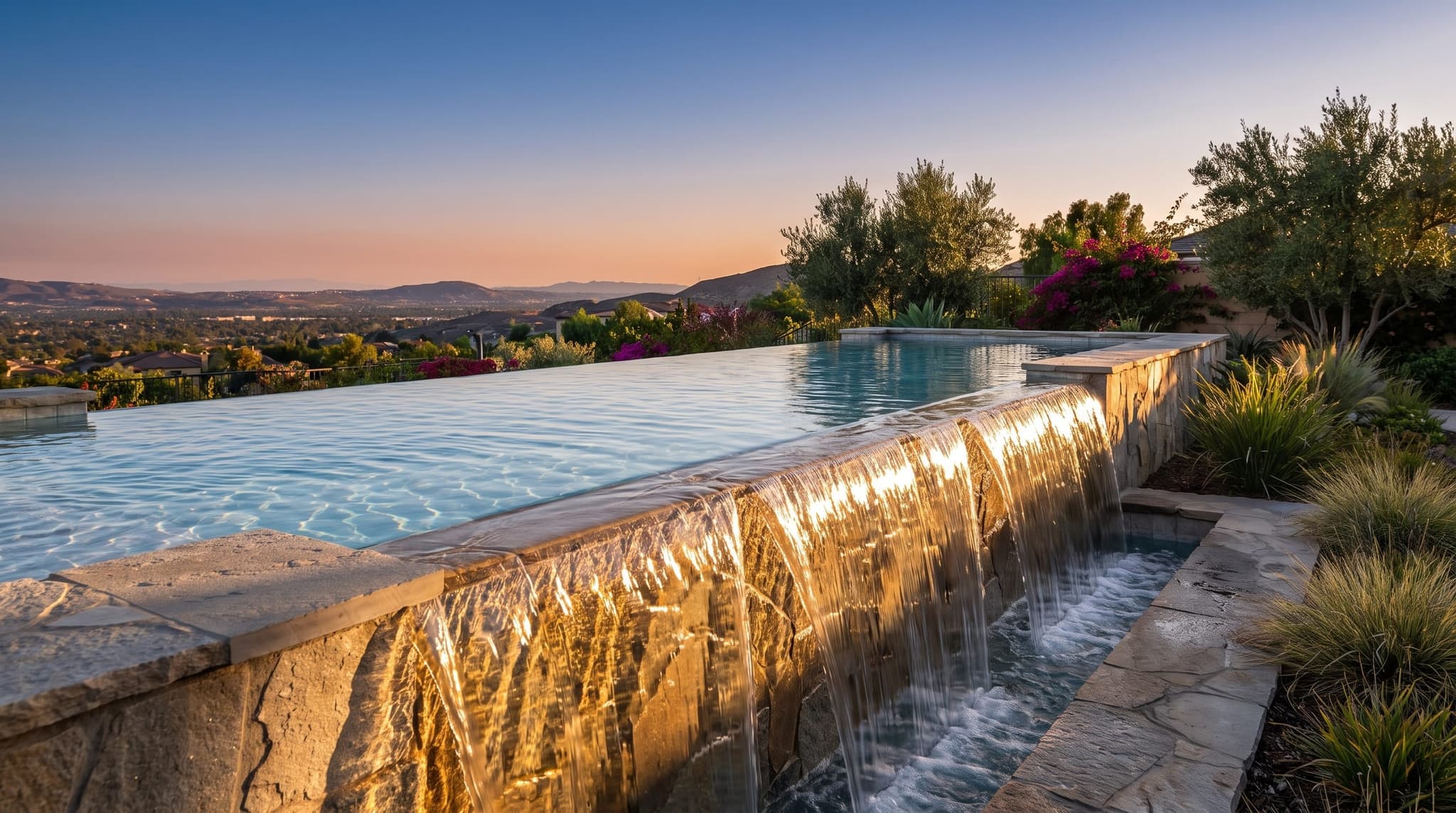
A pool shell where one (or more) edges sit perfectly level with the water surface. A weir, the spillway lip, is cut within about 1/8 inch of level across its entire length. Water flows over it in a continuous sheet, falls into a catch basin below deck level, and is pumped back into the pool. The visual effect is that water and horizon blend. The engineering effect is that the pool acts as a standing wave that requires precise flow control, basin sizing, and waterproof detailing.
How we build a durable vanishing edge
Structural engineering first
Vanishing-edge walls carry water load asymmetrically, one side fully supports water, the other is a cantilever. We engineer the shell to that loading, not a generic spec.
Catch basin sizing
The hidden basin below the weir must hold enough water for the full volume that flows over when the circulation pump shuts off. Undersize the basin and you'll see empty weirs when the pump cycles; oversize and you waste footprint and plumbing cost.
Weir leveling
We laser-level the weir within 1/8 inch end-to-end. Anything less and you'll see thick-spots and thin-spots in the sheet, a dead giveaway of a cheap vanishing-edge build.
Waterproof detailing
The back side of the weir wall sees constant water movement. Proper shotcrete detailing and hydrostatic waterproofing on the outside face are non-negotiable.
Pump & plumbing sizing
An infinity pump runs parallel to the filtration pump and sized for the weir's flow demand. Variable-speed control lets you quiet the edge for dinner or full-blast it for parties.
- Hillside or view lots with a real drop-off to look out over
- Cities with dramatic terrain: Temecula, Lake Elsinore, Chino Hills, Canyon Lake, Yucaipa
- Homeowners who want a standout feature and accept the maintenance premium
- Build budgets $180,000+ where the feature's cost pencils proportionally
Vanishing Edge Pools, frequently asked.
Do vanishing-edge pools leak more than regular pools?
Properly engineered vanishing edges don't leak: the catch basin and weir are part of the system, and water stays within it. Poorly built ones leak at the weir wall or let the catch basin overflow. The difference is engineering and waterproofing, not the concept.
How much does a vanishing edge add to pool cost?
Plan on $59,000 and up for the vanishing-edge feature itself on a typical 30-foot pool: structural engineering, weir wall, catch basin, plumbing, and second pump. Hillside site work (retaining walls, caissons, grading) is separate and often runs $15,000–$60,000+ depending on slope. A vanishing-edge pool on a real view lot typically lands in the $180,000–$350,000 range all-in.
Can I add a vanishing edge to an existing pool?
Almost never practically. The feature requires structural rebuild of at least one pool wall, new plumbing and equipment, and a catch basin below the existing pool level. Adding one to an existing pool costs nearly as much as building a new pool with a vanishing edge. If you want this feature, plan it into the original build.
Does the weir need a perfectly level ground?
The weir itself is laser-leveled within 1/8 inch regardless of ground conditions, we set it on our own engineered wall, not the existing grade. What the ground condition affects is the hillside engineering: bedrock vs. decomposed granite vs. expansive clay each produces different caisson and retaining-wall designs.